TL;DR
- The Month End Close is a critical 5-phase process (Recording Transactions, Reconciliation, Cash Flow Management, Financial Analysis, and Compliance) essential for small business financial health.
- Consistency in the close ensures accurate reporting by reconciling accounts against bank statements, managing overdue invoices for stable cash flow, and providing reliable financial statements (P&L, Balance Sheet).
- A successful monthly close guarantees audit readiness, smooth tax compliance, and replaces unreliable reporting with the clarity and confidence needed for strategic decision-making and growth.
- OBS Financials provides expert oversight and reliable systems, utilizing automated tools and transparent, flat-rate pricing to deliver consistent, stress-free financial management.
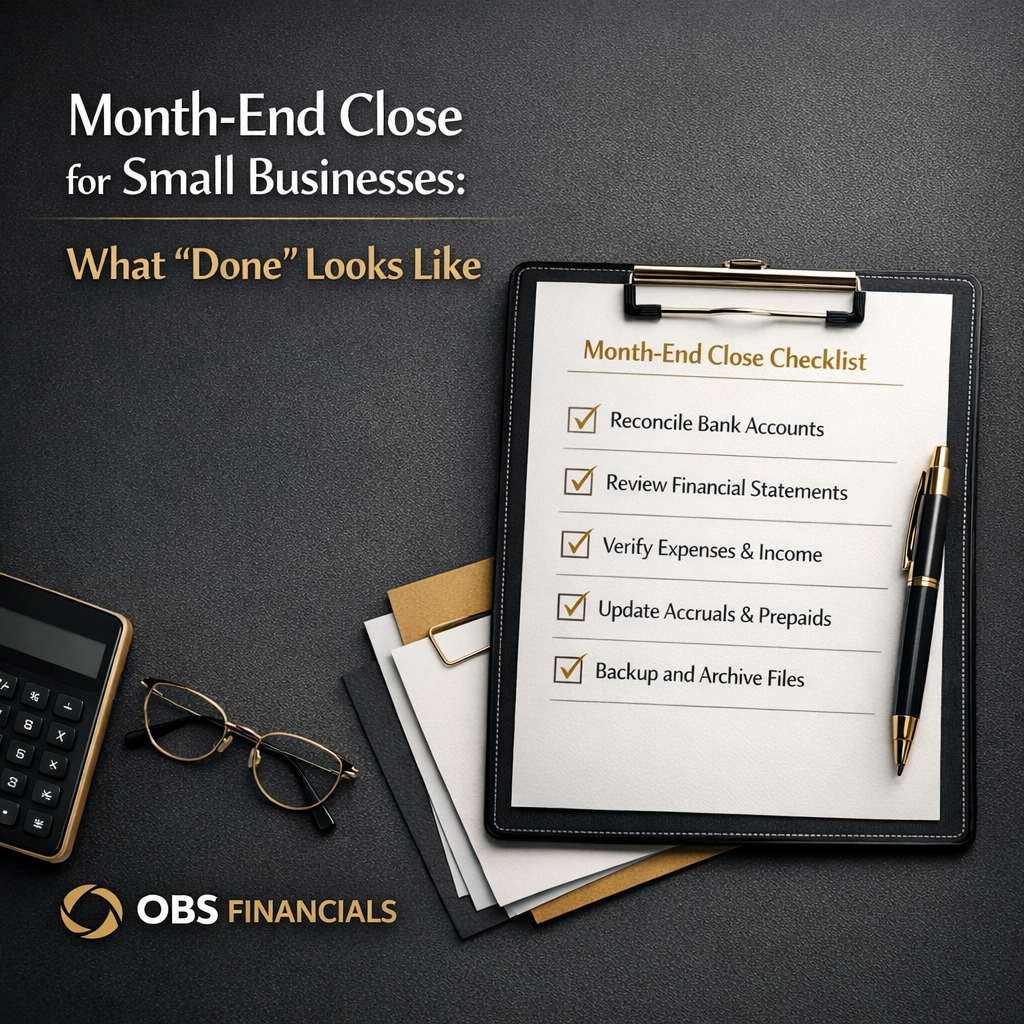
Month End Close Checklist: What “Done” Looks Like
For every Small Business Owner, the month end close is the most important financial exercise you perform. This is the moment you transition from simply spending and receiving money to actually understanding your business’s health.
The goal is simple: achieve accurate, reconciled books that give you true confidence in your numbers. When your books are truly “done” for the month, you have the clarity needed for better decisions and are always audit ready.
Here is the five-phase Month-End Checklist OBS Financials follows to ensure your business finances are clean, accurate, and ready for growth.
Phase 1: Gathering and Recording Commercial Transactions
The first step in any successful month end close is making sure every dollar spent and earned during the period has been recorded. This requires discipline in your financial tracking habits.
Step 1: Capturing Operational Costs of Business and Income Tracking
You must regularly record transactions, meaning every piece of income, every vendor payment, and all business expenses must be entered into your accounting system. Accurate categorization of income and expenses is absolutely vital for regulatory and tax commitment later on.
Many Small Business Owners try to manage this using error-prone manual spreadsheets, which often leads to mistakes and missed deductions. We strongly recommend utilizing an Automated Accounting System that features tools for secure document sharing and a dedicated Feature for Capturing Receipts.
This automated approach simplifies the Recording Commercial Transactions process. Whether you are running a construction company in Rogers or a service firm in Bentonville, keeping track of every operational cost is how you ensure your bottom line is calculated correctly.
Phase 2: Ensuring Accuracy (Reconciliation)
Data entry is only half the battle. Reconciliation is the process that proves your internal records are flawless. This is where we eliminate the stress caused by unreliable reporting.
Step 2: Matching Bank Accounts
Reconciling accounts means comparing the transactions recorded in your accounting software against your actual bank accounts and credit card statements. This crucial step confirms that your recorded transactions match reality.
This is where errors, like missed deposits, duplicate payments, or incorrect expense amounts, are caught. Conducting the Matching Bank Accounts process rigorously at month-end helps identify these mistakes, preventing costly errors that can throw off your annual tax calculations.
Without reliable reconciling accounts habits, you are operating on numbers you cannot trust. OBS Financials focuses on this discipline every month to ensure your data is always dependable.
Phase 3: Managing Cash Flow and Payments
The month end close is not just about looking backward, it is also about ensuring your future cash flow is stable. Poor management of who owes you money is one of the fastest ways to derail a profitable business.
Step 3: Management of Delayed Invoices and Customer Payments
Reviewing your accounts receivable is essential. You need a clear list of all outstanding invoices and customer payments. If you have any overdue invoices, the end of the month is the critical time to follow up.
Effective Management of Delayed Invoices helps maintain a steady Flow of Cash Liquidity. Many modern accounting systems, including platforms like Wave, offer automated reminders and tools to handle Payments via the Internet, drastically reducing late payments and preventing disruptions to your cash flow.
If you are a fast-growing Northwest Arkansas business, consistent invoice management is key to scaling without running into liquidity problems.
Phase 4: Analyzing Financial Performance Tracking
Once the books are clean and reconciled, the data transforms into actionable intelligence. This is the moment the Small Business Owner gets the clarity needed to make strategic decisions.
Step 4: Review of Financial Statements
The core output of the month end close is a set of reliable financial statements. These reports summarize your entire month’s activity and provide essential insight into your Financial Performance Tracking.
We focus on three primary reports: the Statement of Profit and Loss (P&L statement), the Disclosure of the General Budget (Balance Sheet), and the Cash Flow Statement. Automated tools simplify the generation of these reports, aiding in timely analysis.
By comparing these reports month-over-month, you can quickly spot trends, whether that is a rise in key business expenses or a change in income tracking. This analysis helps you price confidently and manage costs before they become major problems.
Phase 5: Setting Up for Compliance
The final phase confirms that your organized records are ready for external scrutiny, reducing your compliance anxiety.
Step 5: Finalizing for Regulatory and Tax Commitment
A successful month end close ensures that your records are perfectly aligned for future tax filings and potential audits. Accurate, consistent monthly records support your Regulatory and Tax Commitment throughout the year.
This proactive monthly review reduces the risk of penalties and ensures you are ready when tax season arrives. We establish systems and documentation that make your business instantly audit ready.
While many Small Business Owners look up quick answers on platforms like YouTube or TikTok, relying on expert, consistent processes is the only way to achieve true Readiness for Financial Review. OBS Financials provides that reliable process, backed by our 10+ years of experience in forensic accounting.
Moving from Checklist to Confidence
Following this detailed Month-End Checklist every 30 days is how your business moves from financial confusion to confidence. For busy founders and operators in the Bentonville area and nationwide, finding time to meticulously record transactions and review financial tracking can be a major stressor.
That is where OBS Financials steps in. We provide the consistent systems and expert oversight needed to manage your entire month end close process. Our flat-rate pricing ensures you receive transparent costs and no surprise invoices.
Stop stressing over messy books and start focusing on running your business. Schedule a free 30-minute consultation today to discuss how we can bring clarity and compliance to your financial tracking.
Why the Month End Close is Essential for Your Business
The end of the month often feels like a rush. As a Small Business Owner, your focus is naturally on serving customers, managing operations, and driving growth.
Because of this pressure, essential financial tracking tasks often fall to the bottom of the priority list. This creates messy books and stress.
Performing a consistent month end close is the single most effective way to gain true confidence in your numbers.
Think of the month end close as a structured financial reset. It ensures that every transaction is accounted for and that your reports are accurate before you begin the next 30 days of work.
This routine provides the clarity you need to make better decisions, manage cash flow, and stay audit ready.
Here in Northwest Arkansas, where fast-growing businesses thrive, clean financial systems are crucial for managing complex multi-location operations. OBS Financials helps Bentonville-area founders and operators establish these reliable, consistent accounting systems.
Gaining Clarity by Recording Transactions
The foundational step of the month end checklist involves accurately recording all commercial transactions. This includes all income tracking and documentation of every one of your business expenses.
Accurate categorization of income and expenses is vital for tax compliance and accurate reporting.
Many small business owners rely on manual spreadsheets, which are often error-prone. Using an Automated Accounting System makes it easier to record transactions consistently, ensuring that your data is reliable.
Ensuring Accuracy by Reconciling Accounts
One of the most important components of the month end close is reconciling accounts. This means comparing your internal records in your accounting software against the official statements from your bank accounts and credit cards.
This matching process catches errors immediately. Without reconciliation, mistakes like missed deposits, duplicate payments, or incorrect recording of expenses can accumulate, leading to numbers you cannot trust.
Conducting reconciliation at the end of the month helps identify these mistakes quickly, preventing costly errors and ensuring your entire accounting system is reliable.
Protecting Cash Flow and Managing Invoices
The month end close is the ideal time to review your accounts receivable, the money owed to you by customers. If you have overdue invoices, this period requires immediate follow-up.
Proactive management of delayed invoices is necessary to maintain steady cash flow. When revenue is predictable, you can plan confidently for future investments or operational costs of business.
Using features in your accounting system for automated reminders helps reduce late payments and keeps your revenue stream flowing smoothly.
Using Financial Statements for Better Decisions
Once your accounts are reconciled and your transactions are recorded, the next step is reviewing your crucial financial statements. These reports show the overall health and financial performance tracking of your business.
You must review the Statement of Profit and Loss (P&L statement), the Balance Sheet (Disclosure of the General Budget), and the Cash Flow Statement (Flow of Cash Liquidity).
These reports provide deep insight into your assets, liabilities, profit, and liquidity. For example, comparing month-over-month data helps you spot unexpected expense spikes or revenue trends early, allowing you to react quickly.
Staying Ahead of Tax Compliance
Accurate monthly bookkeeping is the foundation of hassle-free tax preparation. When you perform a thorough month end close, you ensure that you meet all necessary reporting requirements.
The consistent review of tax obligations, supported by accurate records, dramatically reduces the risk of penalties or problems later.
Clean, finalized books provide the documentation needed for financial review and help your business owner feel secure knowing they are prepared for any regulatory scrutiny.
The OBS Financials Difference
A smooth month end close reduces stress and eliminates the problem of unreliable reporting. When your business finances are finalized monthly, you gain time back that you would otherwise spend fixing errors later.
OBS Financials uses reliable processes, secure document sharing, and features for capturing receipts to streamline this process. We specialize in providing the clarity and systems that help you move beyond messy books and achieve predictable financial management.
The Core Challenge: Fighting Messy Books and Hidden Costs
As a Small Business Owner, you face constant pressure to grow and serve customers. This often means essential financial tracking falls behind.
When you delay the process, you end up with messy books that create significant stress. You may realize you are behind and do not know what is accurate.
This uncertainty leads to unreliable reporting and issues like surprise business expenses, missed payments, and financial statements that simply do not match what you see in the bank accounts.
We understand the fight against inaccurate data and compliance anxiety. Our goal is to counter these problems with reliable, clean accounting system setup and transparent pricing.
We provide the consistent structure needed to manage your business finances. This structure is delivered through a standardized Month-End Checklist, ensuring you know exactly what “done” looks like every single month.
Your Month End Checklist: What “Done” Looks Like for Small Business Owners
A successful month end close brings relief and confidence. Our process relies on consistency to ensure your business finances are accurate every time. Following this Month-End Checklist helps Small Business Owners move from stressing over books to making better decisions.
We break the process into four key phases, ensuring your accounting system is accurate and ready for crucial analysis.
Phase 1: Recording Commercial Transactions
The first step in the month end close is ensuring every financial event is captured in your accounting software. This phase is all about completeness and accurate Recording Commercial Transactions.
1. Collect All Source Documents
You cannot record what you do not have. You must collect all receipts, invoices, and statements for the month.
- Gather physical receipts and file them digitally.
- Review statements from all bank accounts and credit cards.
- Secure documents shared via automated systems, especially using a Feature for Capturing Receipts.
2. Record All Income and Customer Payments
Ensure all revenue earned during the month is recorded for proper income tracking. This includes sales, service fees, and any Payments via the Internet.
- Verify all customer payments received were deposited correctly.
- Generate and send any remaining invoices for the month.
- Accurate categorization of income is vital for tax compliance and reliable financial reporting.
3. Categorize Business Expenses
Every dollar spent must be tagged correctly. This is crucial for tracking the true Operational Costs of Business.
Accurate categorization of business expenses is vital for tax compliance. If you are relying on manual spreadsheets, know that they are highly error-prone.
Using an Automated Accounting System, such as Wave, helps streamline transaction categorization significantly. Review all charges and assign them to the correct category (e.g., rent, utilities, supplies). Always separate business spending from personal spending completely.
Phase 2: Reconciliation and Verification
Once transactions are recorded, you must verify that your books match the real world. This process of reconciling accounts is the heart of reliable bookkeeping and gives the Small Business Owner confidence in their numbers.
4. Matching Bank Accounts and Credit Cards
Reconciling accounts means comparing the transactions recorded in your accounting system against your official bank accounts or credit card statements. This step ensures all data is correct.
By conducting reconciliation at month end close, you identify mistakes such as incorrect recording of deposits or expenses, preventing costly errors before they become major issues. This confirms that the money you think you have is truly there.
5. Review Payroll and Adjustments
Payroll is often the largest business expense and demands careful attention for compliance.
- Verify that all payroll runs for the month were recorded correctly, including wages and taxes withheld.
- Record necessary month-end adjustments, such as depreciation or prepaid expenses.
- Ensure proper worker classification (employee vs. contractor) to maintain strict tax compliance.
6. Management of Delayed Invoices
Management of Delayed Invoices, or Accounts Receivable, is critical. Ignoring this step directly impacts your cash flow and future planning.
Review your aging report and follow up on all overdue invoices. Consistent follow-up helps prevent cash flow disruptions and keeps revenue predictable.
Automated systems, similar to the reminder features found in platforms like Wave, can significantly reduce late payments and improve the overall Flow of Cash Liquidity.
Phase 3: Financial Performance Tracking and Analysis
Once the numbers are verified, it is time to turn data into insight. This phase allows the Small Business Owner to understand their bottom line and plan for growth.
7. Review of Financial Statements
The three primary financial statements must be generated and reviewed. Automated tools, like those available in leading accounting software similar to Wave, simplify the generation of these reports, aiding timely analysis.
- The Statement of Profit and Loss (P&L statement) shows revenue minus expenses, revealing your profitability for the month.
- The Balance Sheet is a snapshot of your assets, liabilities, and owner’s equity at that specific moment.
- The Cash Flow Statement tracks the movement of cash, showing your business liquidity.
8. Analyze Key Trends
Do not just look at the reports, analyze them. This Financial Performance Tracking is how you spot trends and catch problems early.
Comparing month-over-month data is vital. This helps you spot unusual increases in business expenses or unexpected dips in revenue trends early, allowing you to react quickly.
9. Disclosure of the General Budget
If you use a budget, compare your actual results to your forecast. This is the Disclosure of the General Budget step that helps you understand where you overspent or underspent.
- Identify the largest variances between budget and actual spending.
- Use these insights for expansion planning or smarter expense management in the following month.
Phase 4: Finalizing the Close and Ensuring Compliance
The final steps ensure your month is locked down, protected, and ready for future review. This provides the peace of mind that OBS Financials strives to deliver.
10. Meet Regulatory and Tax Commitment
Month end review of your tax obligations, supported by accurate records, reduces penalties and anxiety. This is your Regulatory and Tax Commitment check.
Automated statements and clean recordkeeping aid in preparing for tax filings and audits, ensuring compliance with all reporting requirements. Make sure all necessary documentation is securely stored and easily accessible, ensuring you are audit ready.
11. Close the Books and Archive
Once you are confident in the numbers, formally close the month in your accounting software. This prevents accidental changes to the finalized data and locks in the integrity of your monthly reports.
Archive copies of the finalized reports and supporting documentation. This disciplined approach builds consistent systems you can trust and ensures Readiness for Financial Review.
| Task Type | The Benefit of Completing the Task | Risk of Skipping the Task |
|---|---|---|
| Recording Transactions | Ensures 100% completeness and tax compliance. | Inaccurate P&L, missed expenses, higher tax liability. |
| Reconciling Accounts | Verifies that book balances match the bank accounts, catching fraud. | Uncaught errors, undetected fraud, unreliable cash flow figures. |
| Managing Overdue Invoices | Maintains steady and predictable Flow of Cash Liquidity. | Delayed revenue, potential bad debt, liquidity crisis. |
| Reviewing Financial Statements | Provides clear insight into profitability and supports better decision-making. | Poor planning based on gut feeling, not accurate facts. |
The Necessity of Consistency: Why the Month End Close Matters During Growth
For many Small Business Owners, especially those in fast-growing areas like Northwest Arkansas, scaling operations is the primary focus. Businesses ranging from retail in Rogers to construction in Springdale and professional services in Fayetteville often experience intense busy seasons.
When you are busy hiring new staff and serving more customers, your financial tracking often takes a backseat. This is a primary reason why books get messy during growth spurts.
You may feel like your business finances are out of control. When the books are unreliable, it creates stress and prevents you from making informed decisions about pricing or expansion.
Establishing a consistent, reliable monthly rhythm is critical to solving this problem. A strict month end checklist ensures that even if you have multi-location operations common in NWA, you maintain financial control.
This disciplined approach is what allows OBS Financials to ensure our clients are always audit ready. We provide the structure necessary to move from stressing over disorganized records to achieving confidence in your numbers.
The need for accurate, timely reports is universal. Our remote-friendly processes and secure document handling mean OBS Financials serves clients locally in Bentonville and nationwide.
Whether your small business is focused on local growth or national expansion, a reliable month end close process is the foundation for predictable cash flow and better planning.
Getting Audit Ready: Compliance and Documentation
Being audit ready means having systems in place that remove stress and confusion. This peace of mind is essential for every Small Business Owner.
OBS Financials is 100% insured and certified. We focus on creating reliable processes and documentation that reduce risk for your business finances.
We emphasize strong internal controls. This includes separating duties, ensuring proper Feature for Capturing Receipts, and maintaining clear documentation for every expense and revenue stream.
Ensuring Regulatory and Tax Commitment
One of the most valuable outcomes of a consistent month end close is reliable tax compliance. Clean, categorized records support tax preparation and readiness for any Financial Review.
Consistent bookkeeping significantly reduces the time you spend searching for documentation and fixing issues at tax time. Accurate monthly reports are the foundation of easy tax filing, reducing the risk of penalties related to federal or state reporting requirements.
Worker Classification Basics
Worker classification often causes compliance anxiety. You must correctly classify workers as employees or independent contractors for accurate payroll and 1099 tracking.
A proactive review during the month end checklist ensures that all payroll entries are handled correctly. This prevents costly misclassification penalties later.
Recording Commercial Transactions and Income Tracking
Accuracy begins with timely Recording Commercial Transactions. This means logging all your income, business expenses, and miscellaneous transactions consistently.
Accurate categorization of income and expenses is vital for proper financial tracking and subsequent tax reporting. While manual spreadsheets are highly error-prone, utilizing an Automated Accounting System simplifies this process greatly.
We ensure every transaction is categorized correctly the first time, giving you confidence in your final monthly results.
Reconciling Accounts and Verifying Cash Flow
Reconciliation is the critical step where you verify that your recorded transactions match your actual bank accounts. This process is called Matching Bank Accounts.
Conducting reconciliation at the end of the month helps identify mistakes, such as missed deposits or duplicate payments, preventing costly errors that impact your bottom line.
When OBS handles your month end close, we systematically reconcile all accounts to ensure 100% accuracy in your cash flow reporting.
Management of Delayed Invoices and Customer Payments
A key part of the month end checklist is managing accounts receivable. This means following up on any overdue invoices to maintain stable Flow of Cash Liquidity.
Managing delayed invoices helps prevent significant cash flow disruptions and keeps your revenue predictable. Confirming all expected customer payments have been received is crucial for accurate financial tracking.
Review of Financial Statements and Performance Tracking
The final step in being audit ready is reviewing your primary financial statements. These reports provide critical insight into your profit, assets, liabilities, and liquidity.
The three main reports are the Statement of Profit and Loss (P&L statement), the Balance Sheet (Disclosure of the General Budget), and the Cash Flow Statement.
Using these reports for Financial Performance Tracking is crucial. By comparing month-over-month data, you can spot trends in revenue or Operational Costs of Business early, enabling better decisions.
The OBS Difference: Predictable Pricing and Expert Guidance
We understand that every Small Business Owner needs accounting support that keeps them confident in their numbers. Our approach is built on clarity and deep financial expertise.
Our founder, Luis Orozco, has a Bachelor’s in Forensic Accounting and a Master’s in Financial Planning. This specialized background ensures we apply a strong attention to accuracy and error detection throughout your month end close process.
Flat Rate Pricing for Peace of Mind
Hidden costs and surprise invoices create unnecessary stress. We eliminate this anxiety with flat-rate pricing positioning, meaning, no surprises, transparent costs.
You know exactly what you are paying for every month to achieve a clean month end close. This predictability allows you to focus on running your business, not stressing over unpredictable operational costs of business.
Step One: Recording Commercial Transactions
A successful month end checklist starts with diligently recording income, expenses, and miscellaneous transactions. Accurate categorization of income and business expenses is vital for tax compliance and Financial Performance Tracking.
Many Small Business Owners rely on manual spreadsheets, which are notoriously error-prone. We help implement an Automated Accounting System to manage invoices and streamline data capture.
While various software platforms exist, such as Wave, which offer tools for income tracking and Feature for Capturing Receipts, we ensure your chosen accounting system is configured correctly from day one. This guarantees reliable data for your bottom line.
Step Two: Matching Bank Accounts and Reconciliation
Once transactions are recorded, the next critical step is reconciling accounts. Reconciliation ensures that every recorded transaction matches the actual bank accounts and credit card statements.
This process of Matching Bank Accounts is crucial for catching errors like missed deposits or duplicate payments, preventing costly errors for the Small Business Owner.
Conducting reconciliation at month end helps us identify mistakes quickly, ensuring your business finances are always audit ready.
Step Three: Managing Overdue Invoices and Cash Flow
The month end close is the ideal time to follow up on overdue invoices. Effective Management of Delayed Invoices is essential to maintaining steady Flow of Cash Liquidity.
Systems that offer automated reminders, like Wave, can significantly reduce late customer payments. We help establish consistent protocols for Payments via the Internet and timely management of customer payments.
Strong invoice management keeps revenue predictable and supports your overall cash flow.
Step Four: Review of Financial Statements
The final step in the month end checklist is the Review of Financial Statements. This includes the Statement of Profit and Loss (P&L statement), the Balance Sheet, and the Cash Flow Statement.
Regular review provides critical insight into your assets, liabilities, profit, and liquidity. Comparing month-over-month data helps the business owner spot unfavorable expense or revenue trends early.
These accurate reports support Regulatory and Tax Commitment and reporting requirements. Automated statements aid in preparing for tax filings, reducing penalties, and ensuring Readiness for Financial Review.
Beyond the Close: Strategic Planning
A clean month end close is just the starting point. When you have reliable numbers, you can use them to plan ahead and make better decisions.
We offer CFO services that go beyond recording history. This includes budgeting, pricing guidance, and expansion planning, supported by the Disclosure of the General Budget.
Accurate monthly financials help you price confidently, manage cash flow, and avoid costly surprises, ensuring sustained growth for fast-growing Northwest Arkansas businesses.
Frequently Asked Questions About the Month-End Close
What is the ultimate goal of the month end close?
The ultimate goal is to generate accurate, reliable financial statements. This process ensures that every transaction is recorded, reconciled, and categorized correctly. It gives the Small Business Owner a clear picture of their financial health for the month.
By achieving a successful month end close, you gain the confidence needed to make critical decisions about pricing, hiring, and expansion. It turns unreliable reporting into systems you can trust, directly impacting your bottom line.
How long should a small business month end close take?
For a small business using an Automated Accounting System, the close should ideally be completed within the first five to ten business days of the new month. The cleanup timeline depends heavily on the volume of transactions and how far behind your financial tracking systems are.
Consistency speeds up the process significantly. When you establish consistent month end checklist habits, you spend less time searching for receipts and correcting errors, giving you time back to focus on running your small business.
Why must I record business transactions accurately every month?
Regularly recording commercial transactions, including income tracking and business expenses, is essential for accurate reporting and compliance. Accurate categorization of both income and expenses is vital for correct tax reporting later on.
Many Small Business Owners try to handle this using manual spreadsheets, but this method is highly error-prone. We emphasize using cloud-based tools with a Feature for Capturing Receipts to automate data collection and transaction entry, though human oversight is always necessary.
This consistent habit ensures that when you review your financial statements, the data reflects reality, leading to much better decision-making.
How does reconciling accounts improve my business finances?
Reconciliation is the process of matching bank accounts and credit card statements against the transactions recorded in your accounting software. This discipline ensures your recorded data is accurate and reliable.
Conducting reconciliation at the month end close helps identify mistakes immediately, such as missed deposits, duplicate payments, or incorrect recording of expenses. By catching these errors early, you prevent costly errors and maintain the integrity of your business finances.
This step is non-negotiable for achieving reliable numbers and staying audit ready.
What are the three most important financial statements?
The three most important statements generated during the month end close are the Statement of Profit and Loss (P&L), the Balance Sheet, and the Flow of Cash Liquidity (Cash Flow Statement).
These reports together provide comprehensive Financial Performance Tracking necessary for strategic planning. For example, comparing month-over-month data helps you spot unexpected expense trends or revenue changes early.
The P&L statement shows profitability, the balance sheet shows assets and liabilities, and the cash flow statement tracks the movement of money in and out of your bank accounts.
How does the month end close help me manage cash flow?
A key component of the month end checklist is proactively managing accounts receivable. This means following up on overdue invoices and ensuring timely collection of customer payments.
Consistent focus on management of delayed invoices helps maintain steady cash flow and keeps your revenue predictable. When you know exactly who owes you money, you can plan your operational costs of business much more effectively.
Without this discipline of reconciling accounts, even profitable businesses can face sudden liquidity crises. The close process enforces this necessary review.
Does the month end close help with tax and audit readiness?
Yes, absolutely. Performing a consistent month end close ensures that your income and business expenses are accurately categorized throughout the year. This discipline fulfills your Regulatory and Tax Commitment obligations.
Accurate records and consistent financial statements make year-end tax preparation much smoother, reduce the chance of penalties, and keep you completely audit ready. Our processes at OBS Financials are designed to provide the reliable documentation needed to meet all reporting requirements.
What if I am already behind on my financial tracking?
If you are behind, you need financial cleanup or catch-up bookkeeping. This is often the necessary first step before starting a consistent month end checklist. Many fast-growing Northwest Arkansas businesses struggle to keep up during growth spurts.
OBS Financials specializes in rebuilding reliable systems through comprehensive cleanup projects. We help you get caught up and confident, transforming months of messy data into accurate, reliable business finances.
Once the cleanup is complete, we transition you into a predictable, transparent, flat-rate monthly bookkeeping system, ensuring you never fall behind again.
Gain Confidence and Control Over Your Financial Close
You don’t have to fight the stress of messy books and unreliable reporting alone. OBS Financials provides the systems and expertise necessary to ensure your month end close is done right, consistently, and affordably.
Our goal is to give the Small Business Owner back their time, providing the clarity needed for better decisions.
Stop Fighting Messy Financial Tracking
If you are struggling to accurately record transactions or keep up with reconciling accounts, professional support is essential. We specialize in consistent categorization of all income and business expenses. Accurate financial tracking is vital for smooth tax compliance.
We establish reliable processes that integrate directly with your accounting system to capture every detail. This includes managing incoming customer payments and following up on overdue invoices to stabilize your cash flow.
Receive Clear, Reliable Financial Statements
A successful month end close results in reliable financial statements. We ensure you receive and understand your Statement of Profit and Loss (P&L statement), balance sheet, and cash flow statement promptly.
Reviewing these statements monthly is key to achieving strong Financial Performance Tracking. We help you spot trends, manage costs, and protect your bottom line. This consistent process ensures you are always audit ready and meeting all necessary reporting requirements.
Partner with OBS Financials: Transparent Pricing, Real Results
OBS Financials serves Bentonville-area founders and operators and businesses nationwide through secure, remote-friendly processes. We offer personalized software setup and ongoing guidance tailored to your specific needs.
We believe you should never face hidden costs or surprise invoices. That is why we use transparent, flat-rate pricing for predictable service. Our process-driven approach reduces risk and replaces confusion with control.
Ready to achieve a consistent month end close and gain true confidence in your business finances?
Schedule a free 30-minute consultation today.
*Disclaimer: This content is for general informational purposes and is not legal or tax advice. Always consult a qualified professional for advice specific to your business situation.